How Ceramic Coating Protects Your Car from Sun…
How Ceramic Coating Protects Your Car from Sun Damage The Sun Is Slowly Destroying Your…
You wash your car on Sunday. It looks clean, shiny, almost new.
By Tuesday, the colour looks a little dull. By next month, there are patches where the paint has started to fade. By next year, the clear coat is peeling, and your car looks years older than it actually is.
The culprit? The sun.
Lucknow summers are no joke. Temperatures regularly cross 44°C, and UV radiation beats down on your car’s surface for hours every single day. If you’re looking for a lasting solution — not a quick fix — the best ceramic coating service in Lucknow, offered by experts like Always Dry, is exactly what your car needs.
Before understanding how ceramic coating helps, it’s important to understand what UV exposure actually does to a vehicle’s surface.
Sunlight contains two types of harmful ultraviolet rays — UVA and UVB. Both penetrate your car’s clear coat and work their damage silently over time:
The result is a car that looks faded, patchy, and aged — even if it’s mechanically in perfect condition.
In Lucknow’s climate, this damage happens faster than in most other cities. Between long, blazing summers and intense afternoon sun during spring and autumn, your car’s paint is under attack for nearly 9–10 months of the year.
Ceramic coating is a liquid polymer — most commonly Silicon Dioxide (SiO₂) — that is applied to a car’s exterior surface by hand. When it cures, it chemically bonds with the factory paint, creating a hard, transparent, and semi-permanent protective shell.
This is not a wax. It’s not a sealant. It’s a completely different category of protection.
Here’s what happens at the chemical level:
The SiO₂ molecules fill in every microscopic pore and imperfection in your car’s clear coat. Once cured, the surface becomes flat, ultra-smooth, and hydrophobic. The result is a surface so dense and hard that UV rays, water, chemicals, and contaminants simply cannot penetrate it.
A quality ceramic coating typically measures 9H on the hardness scale — harder than your car’s clear coat itself.
This is where ceramic coating truly earns its value. Here’s exactly how it shields your car from the sun:
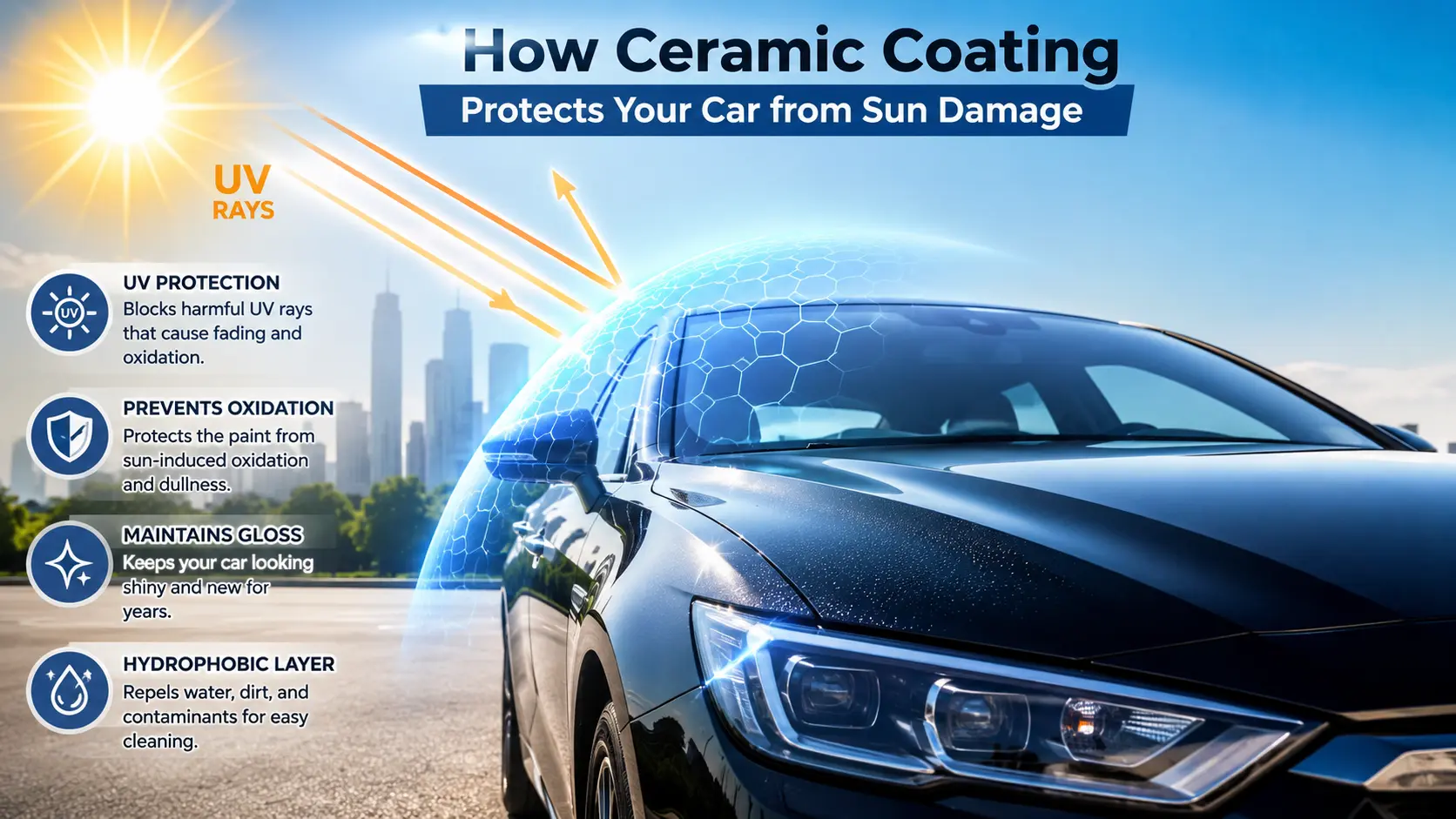
A high-grade ceramic coating acts like a sunscreen for your car. The SiO₂ layer absorbs and reflects UV radiation before it can reach the paint beneath. This dramatically slows down the oxidation process that causes fading and chalking.
Without ceramic coating, UV rays hit your clear coat directly. With ceramic coating, they hit the coating first — and the coating takes the hit so your paint doesn’t have to.
Oxidation is the most visible form of sun damage on a car. It appears as a chalky, dull, or milky finish — especially on darker colours like black, navy, and dark grey.
Ceramic coating creates an airtight, moisture-resistant surface. With limited oxygen contact on the paint surface, the oxidation process is significantly slowed down. Your colour stays deep and vibrant instead of washing out.
Ceramic coatings are thermally stable. They can withstand surface temperatures that would cause wax or paint sealant to melt or degrade. This means the coating doesn’t break down in Lucknow’s peak summer heat, continuing to protect your car throughout the hottest months.
The clear coat is the outermost transparent layer on your car. Once it starts peeling or cracking from UV damage, it’s expensive to repair — often requiring a complete respray.
Ceramic coating sits on top of the clear coat and takes the sun’s punishment. Your clear coat remains intact beneath it, fully preserved.
Every paint colour contains pigments that can be broken down by UV exposure. Reds and blues are especially vulnerable. Ceramic coating filters out a significant portion of UV rays, keeping those pigments stable and preventing the washed-out, faded look that plagued older car paints.
A lot of car owners still rely on regular waxing to protect their cars. It’s cheaper upfront, but it doesn’t last.
Here’s a simple comparison:
Protection Type | UV Protection | Durability | Hardness | Hydrophobic |
Carnauba Wax | Minimal | 4–8 weeks | Very low | Basic |
Paint Sealant | Moderate | 3–6 months | Low | Moderate |
Ceramic Coating | High | 3–7 years | 9H | Excellent |
Wax essentially melts off in summer heat. In Lucknow, a wax coat applied in March can be almost completely gone by May. You’d need to reapply it every 6–8 weeks to maintain any real protection — which adds up in both cost and effort.
Ceramic coating, on the other hand, is a one-time application that delivers consistent protection for years.
Lucknow’s environment is uniquely harsh on car exteriors. The combination of:
…means your car faces a relentless daily assault.
A ceramic-coated car handles all of these threats significantly better than an uncoated one. The hydrophobic surface repels water and contaminants. The hardness resists micro-scratches from dust. And the UV protection keeps the paint colour intact through the brutally long Lucknow summer.
Getting ceramic coating done properly is a process. It’s not a 30-minute job. Here’s what a quality application looks like:
Step 1 — Thorough Wash & Decontamination The car is washed, clay-barred, and chemically decontaminated to remove all embedded dirt, iron particles, and pollutants.
Step 2 — Paint Correction (if needed) Swirl marks, light scratches, and water spots are polished out before coating. You don’t want to lock imperfections under a semi-permanent layer.
Step 3 — Surface Preparation The paint is wiped with an IPA (isopropyl alcohol) solution to remove all polish residue and oils, ensuring maximum bonding.
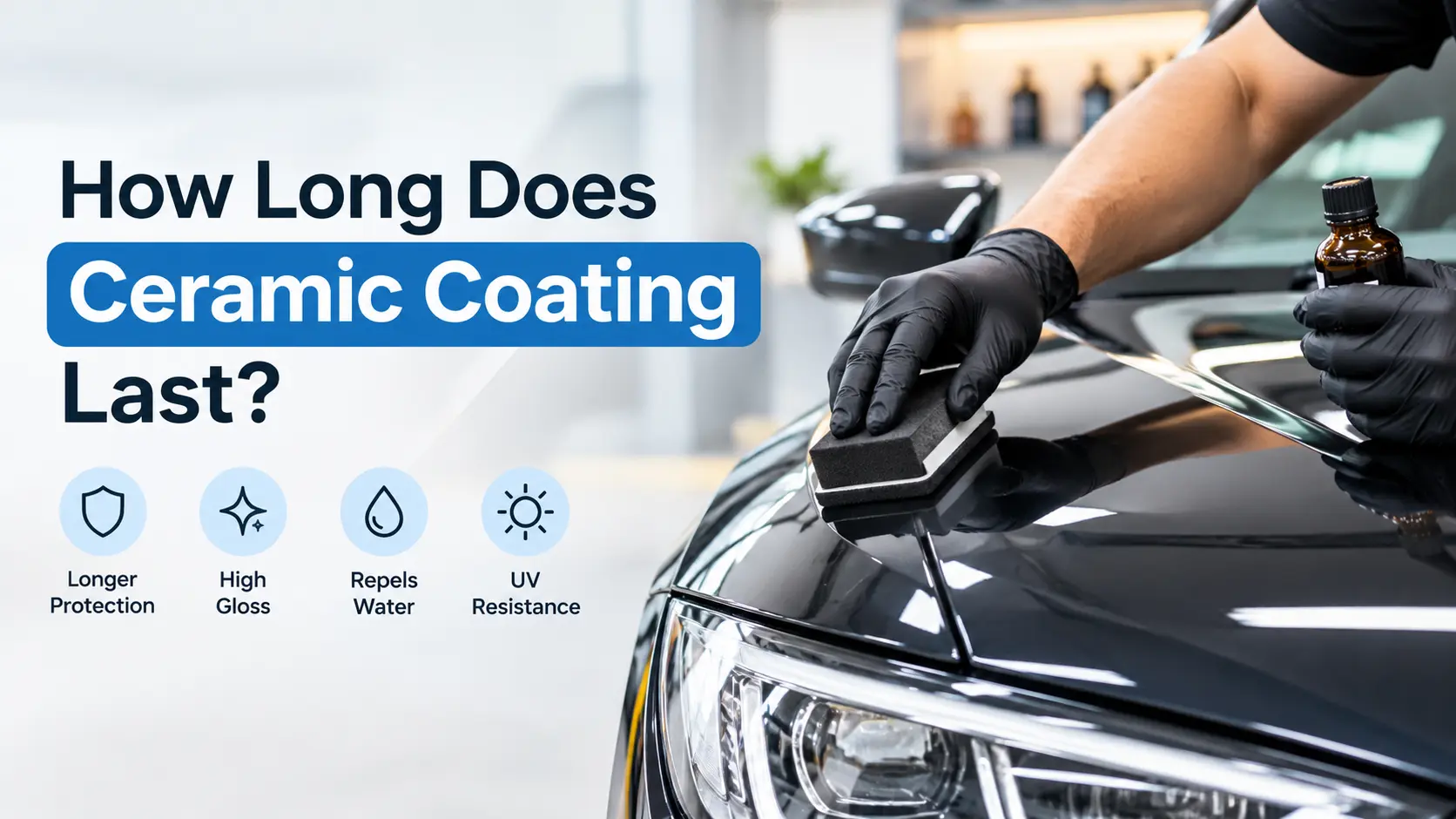
Step 4 — Ceramic Coating Application The coating is applied panel by panel, spread evenly, and buffed off before it flashes. Timing and temperature control are critical here.
Step 5 — Curing The coating cures over 24–48 hours. During this time, the car should stay dry and away from dust.
Always Dry Lucknow follows a detailed, multi-step application process to ensure the coating bonds correctly and delivers its full lifespan of protection.
This depends on the grade of coating applied:
Maintenance is simple: regular washing with a pH-neutral car shampoo and an occasional ceramic booster spray every 6–12 months.
Look for these warning signs on your car:
If you’re seeing any of these, sun damage has already started. Ceramic coating can stop further damage and restore some gloss — though it’s always better to apply it before the damage sets in.
Lucknow’s sun doesn’t take a day off. And neither does the damage it causes to unprotected car paint.
Ceramic coating isn’t just about looks — though a deep, glossy finish is certainly a bonus. It’s a practical, long-lasting shield that preserves your paint, protects your investment, and saves you from expensive respray jobs down the line.
If you’re ready to give your car the protection it deserves, reach out to Always Dry Lucknow for a consultation. Their team will assess your car’s current paint condition and recommend the right coating package for your vehicle and budget.
Your car works hard for you. Give it the protection it deserves.
Ceramic coating significantly reduces UV damage by blocking and absorbing harmful rays before they reach the paint. It won’t make your car 100% invincible, but it dramatically slows fading, oxidation, and clear coat degradation compared to an unprotected surface.
Ideally within the first 1–3 months of purchase. The newer the paint, the better the coating bonds and the more effective the protection. That said, older cars can also benefit after proper paint correction is done before application.
Not directly. If the paint is already faded or oxidised, it needs to be polished and corrected first. Ceramic coating locks in the condition of the paint beneath it — so the surface should be in the best possible state before application.
Yes, when you factor in long-term cost and protection level. Waxing costs less per session but needs to be repeated every 6–8 weeks, especially in Lucknow’s heat. Ceramic coating is a one-time cost that lasts 3–7 years and provides far superior UV protection, hydrophobicity, and hardness.
The exterior coating doesn’t directly protect the interior. However, the UV-blocking property of the coating reduces heat transfer through the car body slightly. For interior protection from sun damage — dashboard cracking, seat fading — a UV-blocking window film or tinting service is recommended alongside ceramic coating.
How Ceramic Coating Protects Your Car from Sun Damage The Sun Is Slowly Destroying Your…