5 Things You Must Do Immediately After Buying…
5 Crucial Things You Must Do Immediately After Buying a New Car Lorem ipsum dolor…

You love your car, and keeping it looking brand new is a priority. But over time, even with regular washing, you might notice that the bright, glossy finish has started to look dull, hazy, or covered in tiny spider-web-like scratches.
When searching for a solution, car owners inevitably come across the term “Paint Correction.” However, because the process involves polishing the top layer of the car, a very common and valid question arises: Is car paint correction safe for my vehicle? Will it ruin or burn through my original factory paint?
The short answer is: Yes, professional car paint correction is 100% safe. But it requires specialized tools, professional knowledge, and patience. In this comprehensive guide, we will break down exactly what paint correction is, the science of how it works safely, the different stages involved, and why it is the ultimate secret to restoring a showroom shine.
To understand why the process is safe, you first need to understand how your car’s paint is structured. Modern vehicles are painted in layers: the bare metal, a primer, the base coat (the actual color of the car), and finally, the clear coat.
The clear coat is a thick, transparent layer of resin that protects the color underneath and gives the car its glossy finish. When your car gets scratched by a dusty cloth, damaged by bird droppings, or etched by hard water, 99% of that damage sits purely in the clear coat layer.
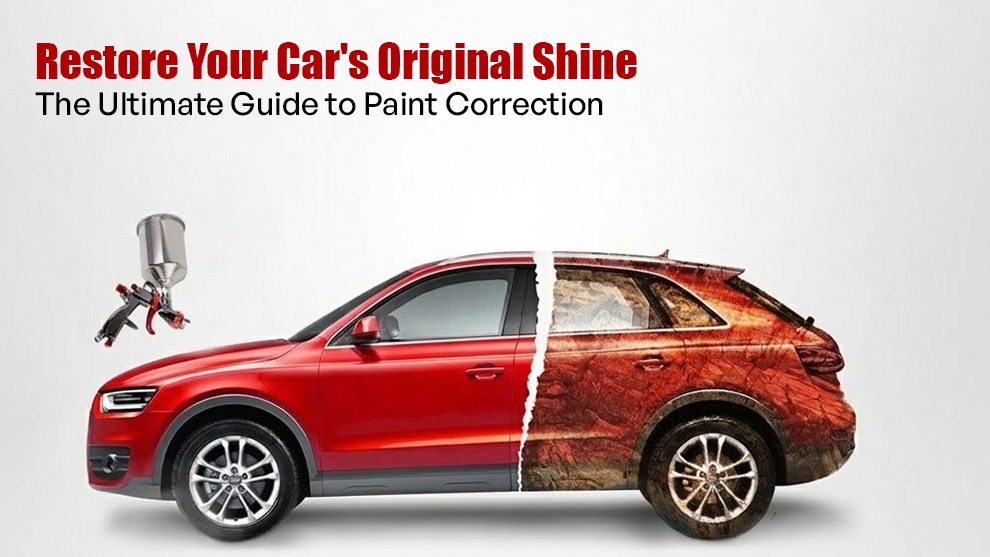
Car paint correction is the meticulous process of using precision machine polishers and abrasive compounds to safely and permanently level out that microscopic top layer of the
clear coat. By flattening the surface, the scratches are permanently removed, and light can reflect perfectly off the car again, creating a mirror-like shine.
Unlike temporary waxes or cheap glazes that simply “fill in” and hide scratches until the next rainstorm, paint correction fixes the root cause of the problem permanently.
The fear of paint damage usually comes from bad experiences at cheap, local car washes where untrained workers use aggressive “rubbing polish” and high-speed rotary machines that generate too much heat.
Professional detailing studios approach this as a science. Here is the precision toolkit that ensures the process is entirely safe:
Before a machine even touches your vehicle, a professional detailer will use an electronic Paint Thickness Gauge (PTG). This tool uses ultrasound or magnetic resonance to measure the exact thickness of your clear coat in microns. If the clear coat is dangerously thin on a specific door or bumper, the detailer knows to use a much gentler approach to ensure the factory paint is never compromised.
Traditional rotary buffers spin in a single, fast circle. In untrained hands, they build up extreme friction and heat, which can instantly burn right through the paint to the bare metal. Professional studios use Dual-Action (DA) Polishers. These machines spin and oscillate (wobble) at the same time. This dual movement disperses heat evenly across the panel, making it virtually impossible to burn the paint, ensuring a 100% safe correction.
A professional detailing bay is equipped with high-intensity inspection lights. These specialized LEDs mimic the harsh glare of the sun, highlighting every single defect, swirl, and hologram. This allows the detailer to see exactly when a scratch has been safely removed so they do not over-polish the area.
What exactly are we safely removing from the clear coat? Here are the most common culprits that ruin a car’s appearance:
Not every car needs the same level of work. Paint correction is categorized into stages based on the severity of the damage.
This is ideal for brand-new cars straight from the dealership or vehicles with very light wash marring. It involves using a finishing polish and a soft pad in a single pass to enhance the gloss, remove micro-swirls, and create a perfectly clean surface.
Designed for cars with moderate damage, swirl marks, and light scratches.
Reserved for older, heavily neglected vehicles with severe oxidation, deep scratches, and heavy water etching. This involves wet-sanding (in extreme cases) followed by heavy compounding, medium polishing, and ultra-fine finishing. It takes days to complete but transforms a heavily aged car into a showroom masterpiece.
If your car’s paint looks dull, you cannot simply cover it up with a protective layer. Applying protection over bad paint is like putting a screen guard over a cracked phone screen—it just seals the damage in.
If you are planning to invest in high-quality PPF for car in lucknow, locking in a flawless, defect-free finish first is absolutely non-negotiable. Because the film is transparent, any swirl marks or oxidation left on the paint will be visible forever underneath the film.
The same rule applies whether you choose film or a premium ceramic coating for car in lucknow; the clear coat surface must be pristine, completely smooth, and decontaminated so the chemical bond or film adhesive can stick perfectly and last for years.
While you can buy polishers and compounds online, attempting a multi-stage paint correction without training is highly risky. Without a paint thickness gauge, you are guessing how much clear coat you have left. Without proper lighting, you will likely introduce more holograms and buffer trails than you remove.
Investing in a professional detailing studio ensures the job is done safely, preserving the integrity and resale value of your vehicle.
Car paint correction is not just safe; it is the most transformative process in the automotive detailing industry. By utilizing scientific measurements, safe machinery, and expert techniques, it breathes new life into tired, faded paintwork.
If your vehicle has lost its luster and you want to restore its original glory safely, it is time to consult with experts who prioritize the health of your car’s paint.
(Looking to restore your vehicle’s paint? Check out our dedicated Car Paint Correction Service to see how our certified experts can safely transform your car today.)
When done by a certified professional, no. A standard clear coat is about 35 to 50 microns thick. A safe, professional paint correction usually removes only 1 to 2 microns of that layer, which is completely negligible and does not affect the long-term integrity of the paint.
Paint correction can completely remove light to medium scratches that sit within the clear coat. However, if a scratch is so deep that you can easily catch your fingernail in it, meaning it has gone down to the primer or bare metal, it cannot be polished out and will require touch-up paint.
Because it is a meticulous, panel-by-panel process, a proper paint correction cannot be rushed. A single-step correction might take 6 to 8 hours, while a multi-stage correction on a heavily damaged vehicle can take anywhere from 2 to 3 full days.
Yes. A traditional “rubbing polish” at a local car wash often uses cheap, aggressive chemicals that strip away too much clear coat and leave behind buffer trails. Professional paint correction uses diminishing abrasives that safely refine the finish to a microscopic level.
Ideally, a car should only need a heavy paint correction once. After the paint is corrected and restored, it should be immediately protected with a Ceramic Coating or Paint Protection Film. With proper washing techniques moving forward, you will never need a heavy correction again.
5 Crucial Things You Must Do Immediately After Buying a New Car Lorem ipsum dolor…
How Much Does Ceramic Coating Cost for Cars in Lucknow? Ceramic coating is a popular…

Real Customer Stories: How Always Dry Lucknow Made Cars Look Brand New Ever wondered how…
Best Practices for Car Maintenance in Lucknow’s Dusty and Humid Climate Lucknow’s unique climate presents…
Why Always Dry Lucknow Is the Top Choice for Car Care Services in the City…